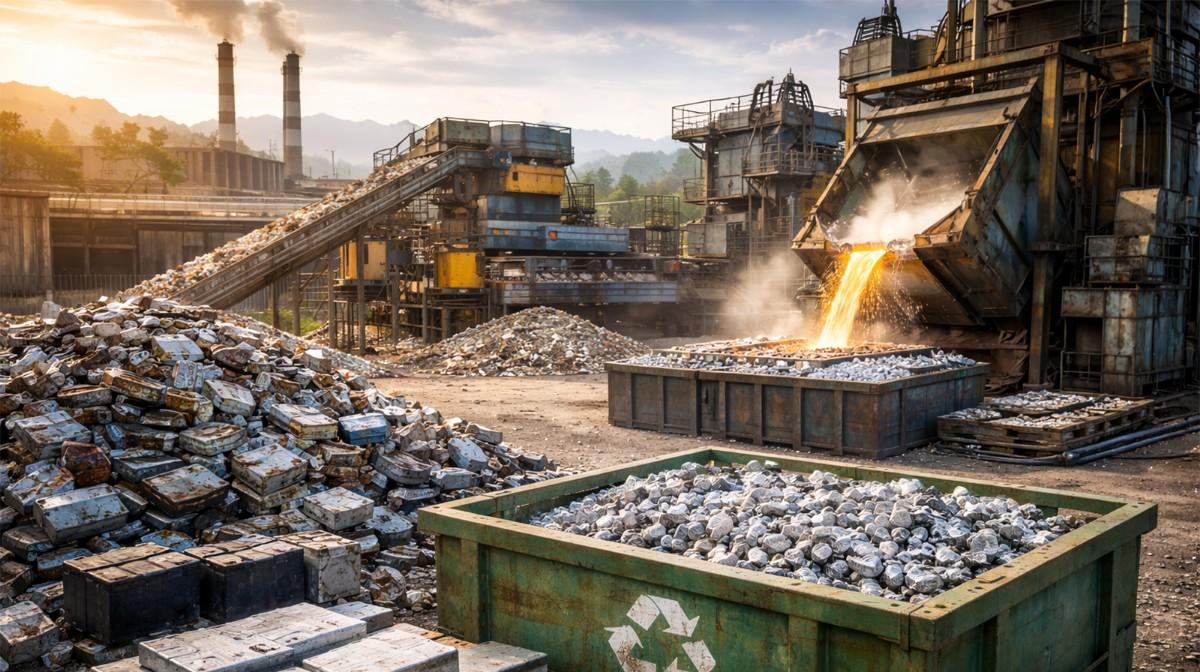
What happens when the batteries that power our cars, homes, and industries reach the end of their life? Do they become waste, or can they be given a second life? In India, the answer increasingly lies in lead recycling plants, which are playing a vital role in closing the loop and driving the nation towards a sustainable, circular economy.
The Growing Demand for Lead in India
India’s lead market has seen steady growth, rising from 1.20 million tonnes in FY2019 to 1.37 million tonnes in FY2024, logging a CAGR of 2.7%. By FY2030, demand is projected to reach 1.9–2.0 million tonnes, growing at an average of 5.4–6.4%.
This surge is fuelled primarily by the lead-acid battery industry, which powers automobiles, inverters, telecom networks, solar applications, and industrial backup systems. With India’s rapid urbanisation, telecom expansion, and ambitious push to scale up solar photovoltaic capacity by 2030, demand for reliable energy storage is only set to grow.
Why Lead Recycling Is Critical
Globally, lead is one of the most recycled metals. In India, 85–90% of lead production already comes from recycling, making it the backbone of supply for the battery industry.
Recycling offers multiple benefits:
- Energy savings: Producing recycled lead requires only one-third the energy compared to mining.
- Environmental protection: Recycling prevents hazardous lead from entering landfills and contaminating soil or water.
- Economic viability: Recycled lead is ~5% cheaper than primary lead, and batteries made with recycled lead are 50–75% less expensive than lithium-ion alternatives.
- Circularity: Lead can be melted and reused endlessly without losing quality, making it perfect for a circular economy.
Secondary Lead: Closing the Loop
With stringent CPCB regulations phasing out unorganised players, the future of lead recycling companies in India lies in scaling up organised, sustainable operations. This shift is not just about compliance but about creating safer workplaces and stronger environmental stewardship.
The Bigger Metal Recycling Ecosystem
While lead remains at the center, India’s recycling story extends across metals. Metal recycling companies in India are driving efficiency by reducing reliance on imported raw materials, lowering carbon footprints, and supporting industries ranging from construction to telecom. Together, these companies form the foundation of a green industrial economy, where every metal recycling process contributes to sustainability.
Building India’s Recycling Future
The lead acid battery industry will remain India’s largest consumer of recycled lead for decades to come. From powering mobility to enabling renewable energy storage, the role of lead recycling plants in India is indispensable.
Among the leaders shaping this transformation is Jain Resource Recycling Limited (JRRL), one of the most trusted names in metal recycling for over 75 years. With a strong presence in both copper and lead recycling, JRRL continues to set benchmarks in safety, sustainability, and efficiency. Their work exemplifies how recycling companies in India can balance industrial growth with environmental responsibility, ensuring that the loop doesn’t just close, but creates lasting value for the economy and the planet.