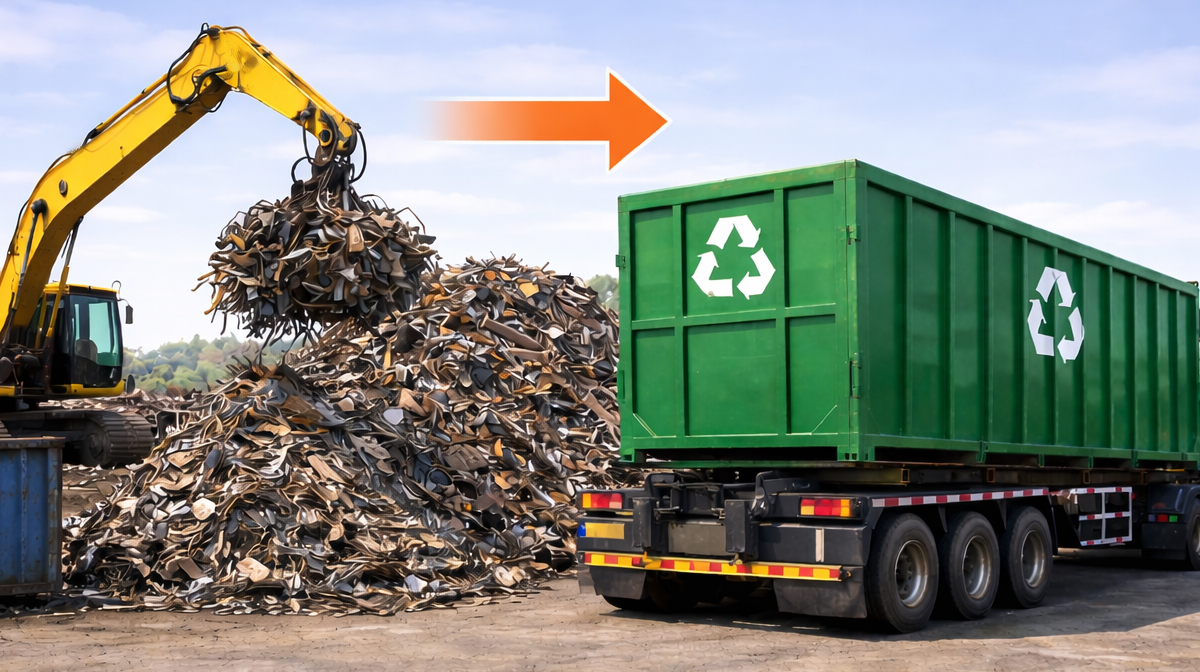
For many, recycling ends the moment scrap leaves a factory floor or is picked up from a site. But in reality, that’s just the beginning. What follows is a highly structured, multi-stage process where discarded material is transformed into high-quality industrial inputs.
At Jain Resource Recycling, we often see this gap in understanding, where the complexity and precision of metal recycling remain largely invisible. This blog breaks down what truly happens after scrap is collected, and how it moves through the system to become valuable again.
Step 1: Collection Is Only the Starting Point
Once scrap is collected, whether from manufacturing units, construction sites, or end-of-life equipment, it enters a controlled supply chain.
At this stage, the focus is on:
- Ensuring traceability of material
- Maintaining segregation at source (where possible)
- Preventing contamination during transport
For an organised scrap recycling company, this stage sets the tone for everything that follows. The better the quality at entry, the higher the efficiency and output downstream.
Step 2: Sorting and Classification
Not all scrap can be processed the same way. Once it reaches the facility, it undergoes detailed sorting and classification based on metal type (copper, aluminium, lead, etc.), purity levels and presence of coatings, insulation, or mixed materials.
For example:
- In copper recycling, high-grade copper wires may be separated for direct processing, while insulated wires require additional treatment.
- In aluminium recycling, materials are sorted into coated and uncoated scrap, with contaminants removed before further processing.
This stage is critical. It determines the recovery rate, energy efficiency, and final product quality.
Step 3: Pre-Processing and Material Preparation
Before metals can be recycled, they need to be prepared.
This involves:
- shredding or cutting large scrap into manageable sizes
- removing non-metallic components such as plastic, rubber, or insulation
- cleaning to eliminate oil, paint, or chemical residues
Advanced facilities use automated systems to improve accuracy and efficiency during this stage. Proper pre-processing ensures that the metal can be melted and refined without compromising quality.
Step 4: Melting and Refining
This is where transformation truly begins.
The prepared scrap is melted in high-temperature furnaces, and impurities are removed through refining processes. Depending on the metal and required quality, different techniques are used:
- Fire refining to remove impurities through oxidation
- Electrolytic refining for high-purity output (especially in copper recycling)
In aluminium recycling, melting consumes up to 95% less energy compared to primary production, highlighting why recycling is both economically and environmentally critical.
At this stage, scrap is no longer waste; it becomes refined metal ready for industrial use.
Step 5: Casting and Re-Manufacturing
Once refined, the metal is cast into usable forms such as, ingots, billets, rods, sheets or slabs.
These forms are then supplied to manufacturers who use them to produce electrical wiring and components, automotive parts, construction materials and consumer goods.
For industries, there is virtually no difference between recycled and virgin metal in terms of performance, making metal recycling a reliable and scalable solution.
Step 6: Re-Entering the Supply Chain
The final stage completes the cycle. The recycled metal is reintroduced into industrial supply chains, where it is used just like primary material.
In many cases, especially for large manufacturers, this creates a closed-loop system:
- Scrap generated during production is collected
- Recycled into usable material
- Fed back into the same manufacturing process
This not only reduces costs but also significantly lowers environmental impact.
Why This Process Matters More Today
With rising demand across infrastructure, automotive, and energy sectors, metals like copper and aluminium are becoming increasingly critical.
- Copper recycling supports electrification, EVs, and renewable energy
- Aluminium recycling enables lightweight, energy-efficient applications
- Recycling reduces dependence on mining and lowers carbon emissions
For industries, this makes recycling not just a sustainability initiative, but a strategic necessity.
The Jain Resource Recycling Approach
At Jain Resource Recycling, we view recycling as more than a process. It is a system that requires precision, scale, and integration.
Under the leadership of Kamlesh Jain, the focus has been on building end-to-end capabilities that ensure:
- Efficient scrap sourcing and handling
- High recovery and minimal material loss
- Consistent quality across recycled output
- Seamless integration with industrial requirements
This approach allows us to move beyond basic recycling and create real value for industrial clients.
Closing the Loop
What happens after scrap is collected is far more detailed and structured than most imagine. It is a journey of transformation, where waste is carefully processed, refined, and returned to the economy as a valuable resource.
As industries move towards more sustainable and circular models, understanding this journey becomes essential. Because in the end, recycling is about redefining how materials are used, reused, and sustained for the future.