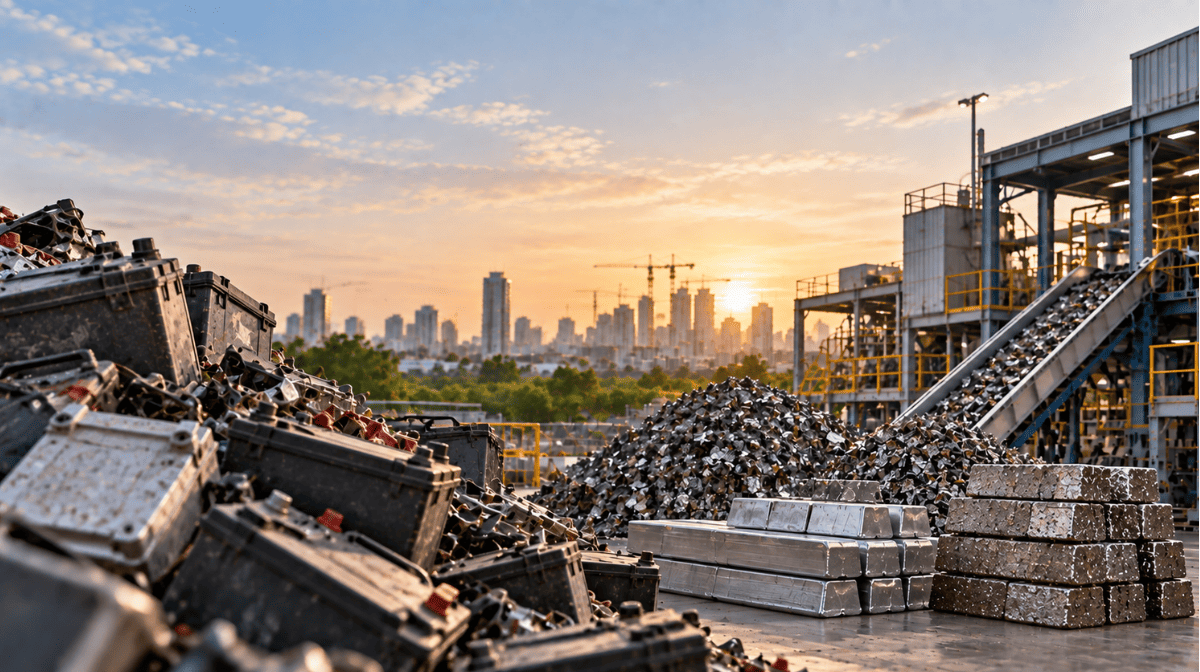
When a lead-acid battery reaches the end of its life and is processed for lead recovery, it can
carry more than lead. Many battery alloys, particularly in older or industrial-grade batteries,
are hardened with small amounts of antimony. Recovering that antimony as a separate,
sellable output, rather than letting it stay locked inside general lead alloy, is what antimony
extraction from battery scrap actually means.
It is a narrow, technical process. But the metal it recovers has become one of the most
closely watched materials in global trade policy over the past two years.
A Metalloid With an Outsized Role
Antimony is technically a metalloid, not a metal, sharing properties of both metals and
non-metals. According to the United States Geological Survey, it is used mainly in flame
retardants and in lead alloys, particularly for lead-acid batteries, and also plays a role in
semiconductors, ammunition, night-vision equipment and other defence applications. It is a
small-volume material with an outsized strategic footprint, which is exactly why its supply
chain has drawn government attention.
Not every lead-acid battery contains meaningful antimony. Battery alloy composition varies
by design and manufacturer, and USGS data shows that antimony content in newer,
maintenance-free automotive batteries has generally declined since the early 2000s in
favour of calcium-lead alloys. Antimony recovery is more relevant to older-design, industrial
and certain starter-battery scrap streams, where antimony-bearing lead alloys are still
common.
A Supply Chain Concentrated in One Country
China produces roughly 48 percent of the world’s mined antimony. In August 2024, it
announced export controls on the metal, effective mid-September that year, and by
December 2024 antimony shipments to the United States had fallen 97 percent while prices
rose 200 percent, according to CSIS. Antimony that traded at under $6 a pound in 2023 hit a
record of roughly $27 a pound in July 2025, per Fastmarkets, before settling into a range of
$26,000 to $47,000 a tonne in early 2026, still three to five times pre-2024 levels.
A partial suspension of the export ban to the US, agreed in November 2025, runs only until
late November 2026. The underlying licensing regime, including a whitelist that authorises
just a small number of Chinese companies to export antimony at all, remains fully in place.
For any country dependent on imported antimony, and India is one of them, that
concentration represents a structural supply risk rather than a temporary price spike.
Where India Is Positioning Itself
India’s Ministry of Mines placed antimony on the country’s official list of 30 critical minerals in
2023. The National Critical Mineral Mission, approved by the Union Cabinet in January 2025,
treats recovery from secondary sources, including e-waste and battery scrap, as part of the
same strategy as fresh exploration, and includes a dedicated ₹1,500 Crores incentive
scheme aimed specifically at building recycling capacity for these minerals.
That’s a policy signal worth noting: for a metal India struggles to mine domestically at scale,
recovering it from material already in circulation is one route to strengthening domestic
supply security, alongside exploration, diversified imports and international partnerships.
Building the Capability
On JRRL’s Q4 FY 2025-26 earnings call held on May 18, 2026, Chief Financial Officer
Hemant Jain confirmed the Company’s antimony project at “around ₹20 Crores” as part of its
planned capex for the coming year. Joint Managing Director Mayank Pareek described the
project directly on the same call: antimony present in the lead used in lead-acid batteries can
be separated out, and free antimony carries better value realisation than leaving it
embedded in the lead alloy. Management has flagged it as a potential profitability driver over
the medium term, built on a recycling stream the Company already processes at scale.
For an industry watching China’s export policy closely, that kind of domestic, scrap-based
recovery is a meaningful piece of the supply buffer that critical mineral strategy is meant to
build.
For Jain Resource Recycling Limited, it reflects a broader pattern in the Company’s growth:
some of the highest-value opportunities lie not in processing more scrap, but in recovering
more from the scrap already being processed.
Sources & References
- USGS – Mineral Commodity Summaries 2025: Antimony
(https://pubs.usgs.gov/periodicals/mcs2025/mcs2025-antimony.pdf) - USGS – Antimony Recycling in the United States
(https://pubs.usgs.gov/of/2003/of03-019/of03-019.pdf) - CSIS – China’s Antimony Export Restrictions: The Impact on U.S. National Security
(https://www.csis.org/analysis/chinas-antimony-export-restrictions-impact-us-nationalsecurity) - Fastmarkets – Antimony 2026: Ample Supply, Strategic Demand
(https://www.fastmarkets.com/insights/antimony-2026-ample-supply-strategic-demand-to-guide-geopolitical-oversight/) - The Oregon Group – China Lifts Export Ban on Gallium, Germanium, Antimony
(https://theoregongroup.com/commodities/gallium-germanium/china-lifts-export-ban-gallium-germanium-antimony/) - Drishti IAS – National Critical Mineral Mission
(https://www.drishtiias.com/daily-updates/daily-news-analysis/national-critical-mineral-mission) - Jain Resource Recycling Limited – Q4 FY 2025-26 Earnings Call Transcript, filed with
NSE, May 18, 2026
(https://nsearchives.nseindia.com/corporate/JAINMETAL_25052026141411_Earnings_Call_Transcript_Q4_sd.pdf)