Key Takeaways:
- India generates approximately 26,000 tonnes of plastic waste every day. Transforming this waste into industrial-grade material is the foundation of a modern circular economy.
- Stricter Extended Producer Responsibility (EPR) mandates requiring up to 40% recycled content in rigid plastic packaging by 2026-2027 are driving unprecedented industrial demand for high-quality recycled polymers.
- Recycled plastics, particularly Polypropylene (PP) and Polyvinyl Chloride (PVC), are highly valuable secondary raw materials that drastically reduce the energy requirements of industrial manufacturing.
- Jain Resource Recycling utilizes an integrated recovery system to process plastic waste into uniform, tested PPCP and PVC granules for direct industrial application.
The Shift: From Plastic Waste to Manufacturing Material
For years, the conversation around plastic has largely focused on what happens after it is discarded. Today, the focus has shifted to a more critical economic question: what value can be recovered from plastic waste?
For manufacturers across India, this is becoming increasingly relevant. India generates massive volumes of plastic waste daily. Instead of routing this to landfills, plastic recovered through organised recycling can be processed into usable, high-grade materials and returned to industrial applications.
The journey from discarded plastic to a usable industrial input requires structured processing. Because plastic waste can contain impurities and may be mixed with other materials, organised recycling focuses heavily on segregation and refinement.
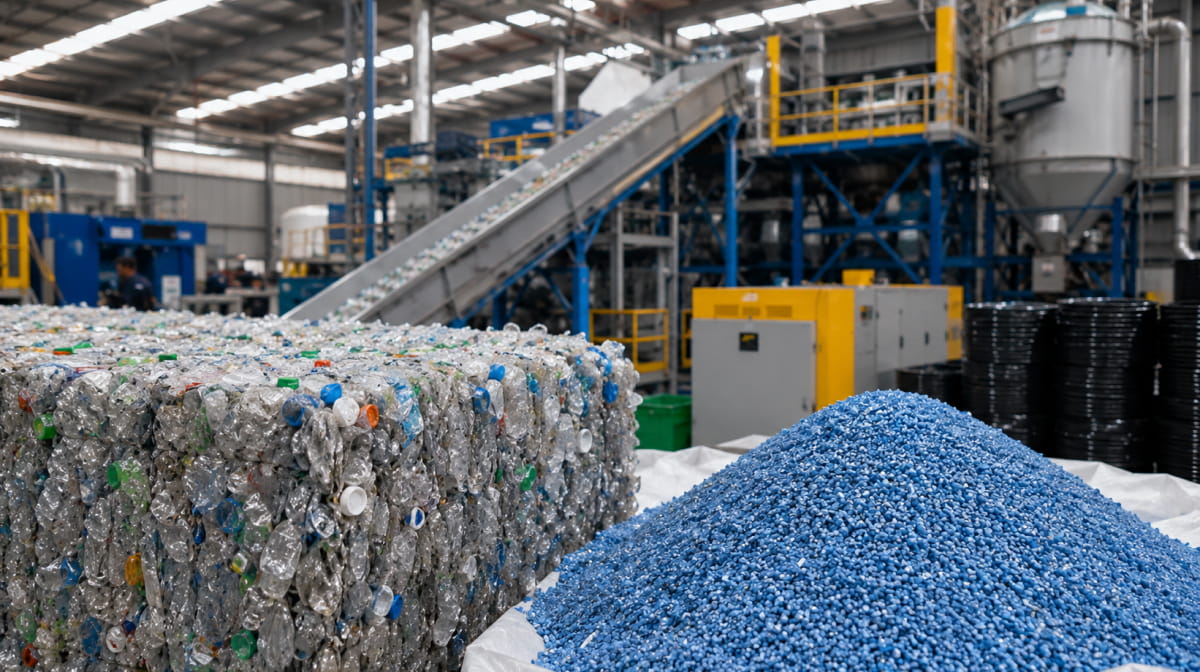
The standard material journey follows a strict sequence: Recovery → Crushing and washing → Segregation → Drying → Processing → Granulation → Industrial use
The objective is to transform recovered plastic into a consistent, reliable material that can be used for demanding manufacturing applications, cementing its role in the circular economy.
The Regulatory Push for Circular Manufacturing
The transition toward recycled plastics is not just driven by sustainability goals; it is now a regulatory requirement. Under the latest amendments to India’s Plastic Waste Management Rules (EPR guidelines), the government has instituted mandatory recycled content targets.
By the 2026-2027 financial year, manufacturers using Category I (Rigid Plastic Packaging) are required to incorporate 40% recycled plastic content into their packaging. This regulatory shift mandates that supply chains pivot from virgin plastics to highly processed secondary materials, accelerating the need for industrial-scale plastic recovery.
Where Recycled Plastics Create Industrial Value
Recycled plastics can support a diverse range of heavy manufacturing applications depending on the type and quality of the recovered material. Materials such as Polypropylene Copolymer (PPCP) and PVC can be processed into premium granules utilized in automotive components, construction materials, industrial transit packaging, and electrical housings.
Integrating recycled plastic creates value across the supply chain by:
- Resource recovery: Useful material is successfully mined from existing waste streams.
- Waste reduction: Plastic is processed for durable, long-term use instead of being treated as a residual liability.
- Material efficiency: Recovered resources are returned to productive applications, lowering the carbon footprint associated with virgin polymer extraction.
- Circular manufacturing: Materials move securely back into domestic industrial supply chains, protecting manufacturers from global raw material price shocks.
Recovering More Value Through Integrated Recycling
Sustainable manufacturing includes how materials are sourced, processed, and used. At Jain Resource Recycling, our focus is on recovering maximum value from the materials we process.
Plastic recovered during our recycling operations includes PPCP chips and PVC grind. Instead of treating these materials as waste, we process them into high-quality PPCP and PVC granules tailored for industrial applications.
For PPCP granules, our integrated process includes:
- Crushing and washing: The material is reduced in size and washed multiple times to remove dust and heavy metal traces (such as lead).
- Segregation and drying: Advanced floating tanks help isolate impurities before the material is thoroughly dried and segregated by grade.
- Magnetic separation and pelletising: Ferrous particles are magnetically extracted before the plastic is extruded and converted into uniform granules.
- Testing and dispatch: The final granules undergo rigorous quality testing to ensure they meet exact industrial specifications before dispatch.
This integrated approach allows us to recover value from material streams generated within our recycling ecosystem and convert them into standardized products for further industrial use.
What This Means for India’s Manufacturing Ecosystem
As India’s manufacturing base expands, the efficient use of materials will remain the cornerstone of sustainable industrial growth. The opportunity lies in viewing recycling and manufacturing not as separate industries, but as connected parts of the exact same value chain.
As sustainable manufacturing continues to evolve in India, recycled plastic materials will play an increasingly vital role in building circular, resource-efficient, and highly resilient industrial systems.
Frequently Asked Questions (FAQs)
How are EPR rules changing plastic manufacturing in India?
Extended Producer Responsibility (EPR) amendments require manufacturers to meet strict targets for integrating recycled plastic into their products. For instance, rigid plastic packaging must contain 40% recycled content by 2026-2027, creating massive demand for high-quality recycled polymer granules.
What industrial applications use recycled PPCP and PVC granules?
Recycled Polypropylene Copolymer (PPCP) and PVC granules are widely used in durable goods manufacturing. Common applications include automotive interior components, industrial transit crates, electrical cable insulation, piping, and construction profiles.
Why is integrated plastic recycling important for manufacturers?
Integrated recycling ensures that plastic waste goes through a rigorous, controlled process—including magnetic separation, multi-stage washing, and quality testing. This guarantees that the final recycled granules have the consistent purity and structural integrity required for heavy industrial manufacturing, allowing companies to meet sustainability targets without sacrificing product quality.